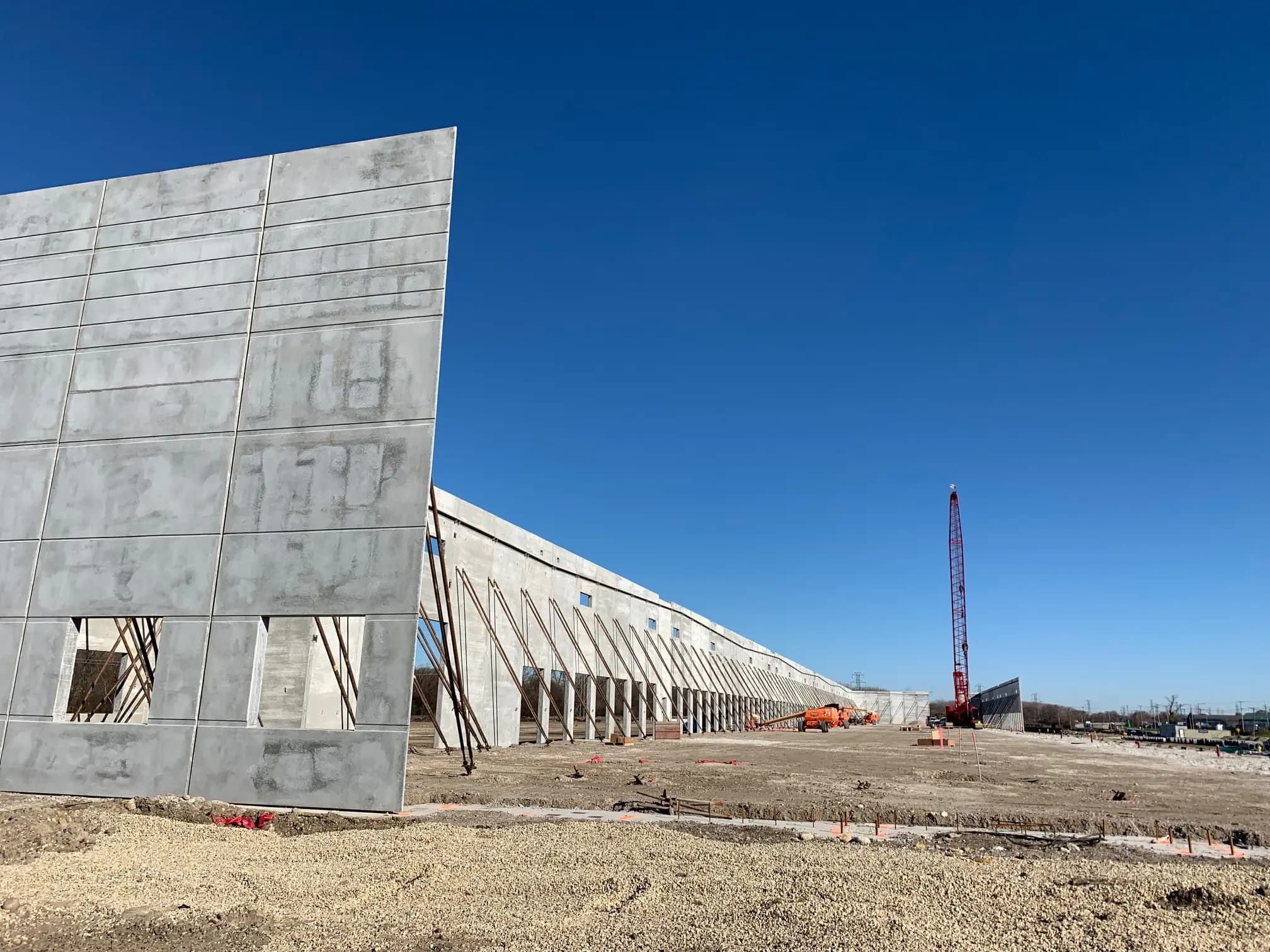
What Our Truck Terminal Construction Scope Covers
General Contractors of Denton delivers truck terminal construction for LTL carriers, truckload operators, freight brokers, and logistics companies building terminal facilities at Denton County's I-35 logistics node. Truck terminal construction is a specialized project type. Dock door count, dock well depth, truck court geometry for simultaneous backing operations, drive-through capabilities, driver amenities, fuel island design, and heavy-duty paving sections all have to be designed around the specific terminal's freight volume and operational pattern.
Denton County terminal sites have specific local conditions. I-35 frontage sites require TxDOT access permit coordination that governs driveway locations, deceleration lane requirements, and median opening approvals. City of Denton utilities and applicable Denton County MUD providers have to confirm electrical service availability for the terminal's office, lighting, dock equipment, and fuel system loads. Eastern Cross Timbers geology requires pavement section engineering for heavy truck loads that differ from standard commercial pavement design.
We have coordinated truck terminal delivery across the North Texas logistics market. We understand the dock door count versus truck-court depth tradeoff that determines whether a terminal can simultaneously operate at full capacity. We understand how driver facility placement, fuel island geometry, and scale house placement affect daily terminal flow. We build those operational requirements into the site design during preconstruction rather than discovering after permits are issued that the site plan does not support the intended operations.
Truck terminal construction is delivered as a coordinated site and building program. Dock doors, truck court, heavy-duty paving, fuel island, driver facilities, and scale house are managed as one integrated delivery scope.
- TxDOT access permit coordination for I-35 corridor truck terminal sites with frontage access requirements.
- Dock door count and truck court depth design based on freight volume and simultaneous backing operation requirements.
- Heavy-duty concrete paving section design for loaded semi-trailer axle loads — engineered sections appropriate for the terminal's daily truck volume.
- Fuel island design and underground storage tank permitting coordinated with the Texas Railroad Commission.
- Driver amenity facility design — shower rooms, locker rooms, break areas, and dispatch office.
- Scale house design and truck scale foundation coordination.
- Terminal office construction with dispatch, operations, and administrative space.
- Security fencing, lighting, and access control system coordination.
How We Deliver Truck Terminal Construction in Denton County
Truck terminal delivery begins with site logistics and operational flow design — the dock count, truck court geometry, and access design have to be confirmed before the site plan is permitted.
Site Logistics and Operational Flow Review
We begin with a detailed review of the terminal's operational pattern — daily freight volume, door count requirements, simultaneous backing operations, driver population, fuel dispensing volume, and scale requirements. For Denton County I-35 corridor sites, we simultaneously review TxDOT access permit conditions to confirm that the driveway locations and truck court geometry the terminal requires are compatible with what TxDOT will permit at the specific site. Operational requirements and access permit conditions that are not compatible require site plan revision before permits are submitted.
Heavy-Duty Pavement Design
Truck terminal pavement in Denton County requires engineered sections for the specific truck loading frequency and Eastern Cross Timbers subgrade conditions. We coordinate geotechnical investigation before pavement section design is finalized. Concrete pavement is typically preferred for high-frequency truck areas — dock aprons, fuel island approaches, and primary truck court areas — because concrete's load distribution performance significantly exceeds asphalt under sustained heavy truck loads in North Texas heat.
Dock and Building Design
Terminal building design is organized around the dock system — door count, door spacing, dock well depth, leveler specifications, and dock seal design for the freight types the terminal handles. Driver amenity facilities, dispatch office, and administrative space are integrated with the terminal building design rather than planned as afterthoughts. We coordinate the building program with the civil design so dock approaches, driver parking, and building access are aligned.
Fuel System and Underground Tank Permitting
Fuel island construction requires TCEQ Underground Storage Tank permit coordination, spill containment design, dispenser installation, and canopy construction. We coordinate the fuel system with the applicable permitting authority and the terminal's fuel management program before construction begins.
Operational Readiness and Startup
Truck terminal turnover is organized around the freight operator's first operational day. We coordinate fuel system commissioning, scale calibration, dock equipment testing, and security system activation before turnover so the terminal can begin freight operations without outstanding punch items that affect daily use.
Truck Terminal Types in Denton County
Truck terminal construction in Denton County serves LTL break-bulk terminals, truckload relay terminals, and owner-operator service facilities at the I-35 split.
LTL Break-Bulk Terminals
LTL carriers operating in the DFW market use Denton County's I-35 split position for break-bulk consolidation and deconsolidation. These terminals require high dock-door counts relative to building size, efficient truck court layouts for simultaneous backing, and freight-handling equipment areas inside the terminal building.
Truckload Relay and Driver Exchange
Truckload operators use relay terminals at Denton County's I-35 position for driver exchanges on long-haul runs between Texas markets and Oklahoma, Missouri, and Kansas City. Relay terminals need driver amenity facilities, sleeper-berth parking capacity, and fuel islands as primary requirements alongside modest dock facilities.
Owner-Operator Service Facilities
Independent owner-operators and small carrier fleets staging from Denton County need service facilities that combine fuel dispensing, truck parking, basic maintenance capabilities, and dispatch access. These facilities are smaller than major carrier terminals but require the same attention to heavy-duty pavement design and truck-circulation geometry.
Intermodal and Cross-Dock Facilities
Cross-dock facilities at Denton County's logistics position serve freight movements that require trailer-to-trailer transfer without warehouse storage. Cross-dock design requires specific dock door layout, interior dock width for straight-through freight movement, and truck court geometry on both the inbound and outbound sides simultaneously.
Why Freight Operators Choose General Contractors of Denton for Truck Terminal Construction
Truck terminal construction is operationally demanding from the first day of use. Pavement that was not engineered for the actual truck loads will fail within months of opening. Truck court geometry that was not verified against simultaneous backing operations will create daily operational bottlenecks. Access permit conditions that were not confirmed before design will require expensive redesign after the permit is in review.
We address all of those requirements in preconstruction — operational flow review, TxDOT access coordination, heavy-duty pavement design, and dock geometry confirmation — before any permits are submitted. The additional front-end investment protects the freight operator's schedule and prevents operational problems that would otherwise surface on day one.
For freight companies investing in Denton County's I-35 logistics position, we deliver terminal facilities that support the intended freight volume from the first operational day — not facilities that require remediation because operational requirements were not built into the design.
Truck terminal construction work is available throughout Denton, Sanger, Krum, Northlake, Argyle, Corinth, Lake Dallas, Lewisville, Carrollton, and the I-35 logistics corridor across Denton County.
Nearby Denton markets for this service
Denton
Denton is the county seat and economic center of Denton County — home to the University of North Texas (46,000+ students), Texas Woman's University, Peterbilt Motors, Sally Beauty Holdings, and a manufacturing base that has anchored the north DFW economy for generations. Commercial and industrial construction here serves a market shaped by university growth, established corporate campus programs, and the ongoing US-380 corridor explosion that is pulling new development east and west of the city.
View marketCorinth
Corinth sits at the southern end of Denton County along I-35E, positioned between Denton and the Lewisville Lake recreation zone with direct highway access to the Dallas–Fort Worth core. The city has attracted retail, office, and service commercial development serving the south Denton County residential base, and its I-35E frontage creates industrial and logistics potential that the surrounding residential growth is beginning to activate.
View marketLake Dallas
Lake Dallas is a small city on I-35E at the Lewisville Lake shoreline, serving as a commercial service node for the lake-adjacent residential communities of south Denton County. Commercial construction here is primarily service commercial, retail, and light industrial — serving the lakefront population and the I-35E traffic corridor between Denton and Lewisville.
View marketHickory Creek
Hickory Creek is a small south Denton County city on I-35E between Lake Dallas and Highland Village, positioned at the Lewisville Lake-adjacent zone where highway-facing commercial development serves the south Denton County residential market and the lake-adjacent recreation economy. Commercial construction opportunities focus on I-35E corridor retail, service commercial, and light industrial.
View marketArgyle
Argyle is southwestern Denton County's premier address — an Argyle ISD community anchored by the Robson Ranch 55+ master-planned community and the equestrian estate properties along the I-35W corridor. Commercial construction here serves a high-income residential base, equestrian facilities, and the growing US-377 commercial zone serving south Denton County's most affluent market segment.
View marketFrequently asked questions
What TxDOT permits are required for truck terminals on I-35 in Denton County?
Truck terminal access to I-35 in Denton County requires TxDOT Denton District access permits for commercial driveways, which govern driveway locations, widths, and deceleration lane requirements based on traffic volume and site characteristics. TxDOT may also require traffic impact studies for high-volume terminals. We coordinate with TxDOT Denton District during preconstruction to confirm access permit requirements before the site plan is designed.
What pavement thickness is required for truck terminal dock aprons in Denton County?
Truck terminal dock aprons subject to loaded semi-trailer axle loads typically require concrete pavement sections of 8 to 12 inches in thickness over prepared subbase, depending on geotechnical conditions and truck loading frequency. Eastern Cross Timbers subgrade requires site-specific geotechnical investigation before pavement section design is finalized. We coordinate pavement section design with the geotechnical investigation for each truck terminal project.