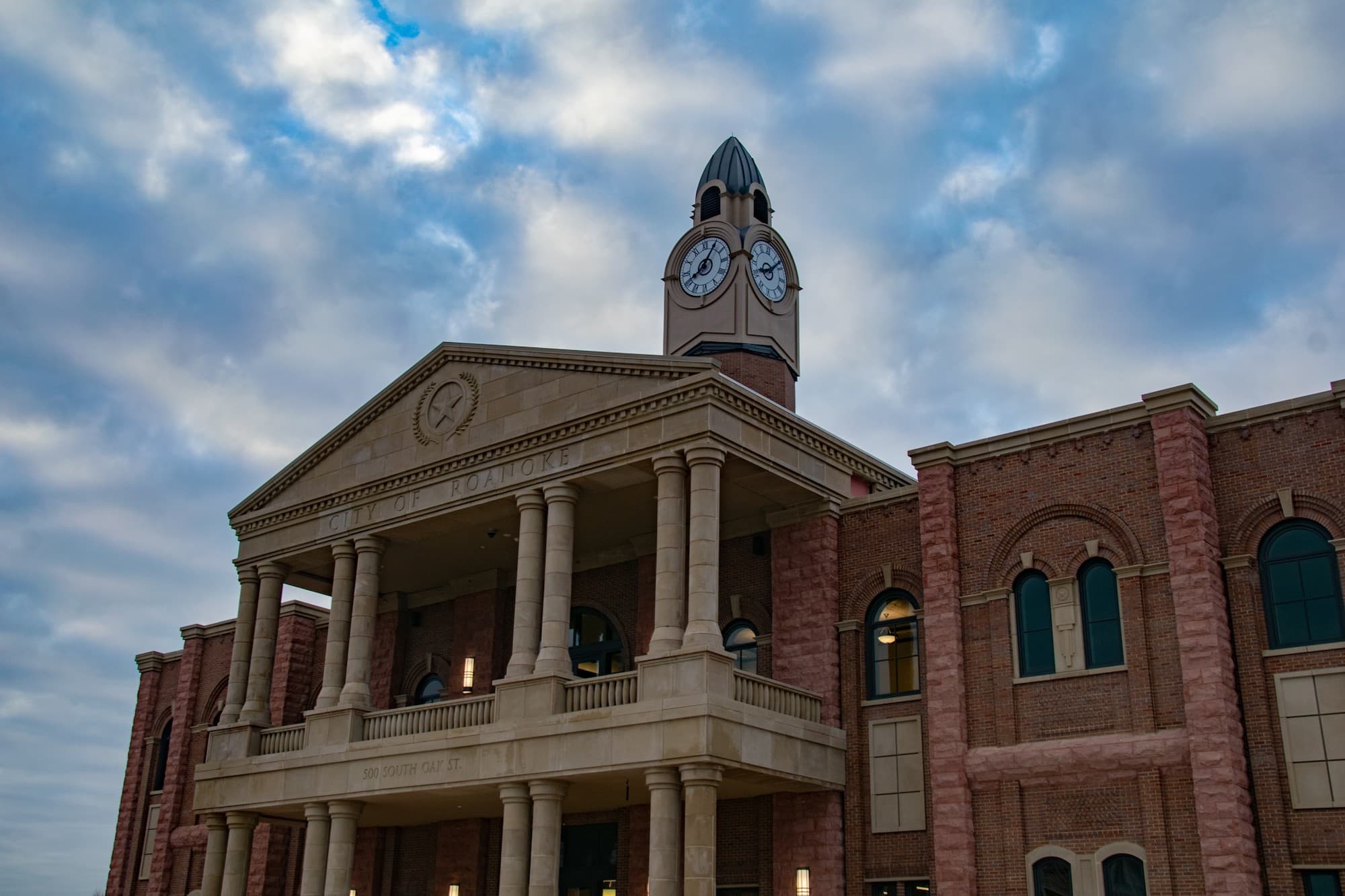
Roanoke Construction Market Overview
Roanoke sits at the center of one of the most active industrial corridors in North Texas — the Alliance Airport area along SH 114 and I-35W in southwestern Denton County. Its position between the Alliance industrial complex to the south and the Denton County ETJ to the north makes it a natural connector market for industrial, logistics, and commercial projects that need Alliance-area access without Alliance-area land prices.
Roanoke's commercial and industrial market is defined by its highway position. SH 114 cuts east-west through the city, connecting the Alliance Airport industrial complex in Tarrant County to the southwest with the broader Denton County commercial market to the northeast. I-35W provides additional regional freight connectivity. That combination of two major highway corridors makes Roanoke a practical staging point for industrial users, logistics operators, and commercial developers who need Alliance-area access but are looking at land costs and site availability in the southern Denton County market.
The Alliance Airport Industrial Center — one of the largest master-planned industrial parks in North Texas — has absorbed enormous amounts of distribution, e-commerce fulfillment, and manufacturing investment over the past two decades. As that market has matured and industrial land within Alliance itself has become constrained and expensive, users have looked to adjacent markets including Roanoke and neighboring Northlake for comparable access at more competitive land costs.
Roanoke itself has developed a notable retail and restaurant character along its downtown and along SH 114 that distinguishes it from purely industrial markets in the Alliance corridor. The city is known for its restaurant row and its small-city commercial character, which creates a mixed commercial context where industrial projects along the highway frontage coexist with restaurant, retail, and small-format commercial serving the city's residential population.
We approach Roanoke's commercial and industrial work with an understanding of both the industrial corridor dynamics and the city's own development requirements. The City of Roanoke has become increasingly sophisticated about the type of commercial development it approves along its SH 114 frontage, and owners planning industrial or commercial projects here benefit from a builder who has worked through the city's review process.
Facility Types We Support In Roanoke
Roanoke's commercial market spans industrial and logistics facilities along the SH 114 corridor, restaurant and retail serving the city's distinctive small-commercial character, and owner-user commercial supporting the area's residential growth.
Industrial and Distribution Facilities
Industrial construction in Roanoke is primarily oriented toward the SH 114 and I-35W corridors where freeway access supports distribution, light manufacturing, and logistics operations. These projects require efficient truck court design, durable concrete flatwork, adequate dock positions, and power capacity appropriate to the tenant's operational requirements. The industrial land in Roanoke that has good freeway access also tends to have utility routing challenges that need to be addressed during site plan review, and we work those issues out in preconstruction rather than discovering them after the permit is issued.
Flex-Industrial Buildings
Flex-industrial buildings in Roanoke serve owner-users and small logistics operators who need a combination of office and warehouse space in a single building. These projects typically run from 5,000 to 30,000 square feet and require dock or grade-level loading, clear height appropriate to the user's storage or operational needs, and office finishes that reflect the professional character of the business. We build flex-industrial shells and owner-user facilities in Roanoke with the same preconstruction discipline we apply to larger industrial programs.
Restaurant and Retail Commercial
Roanoke's restaurant row and SH 114 retail corridor have established a commercial character that attracts dining and retail operators looking for a distinct small-city commercial environment. Restaurant pads, drive-through commercial, and small-format retail along SH 114 need to meet the City of Roanoke's commercial design standards while delivering the operational functionality that food and beverage operators require — appropriate grease trap and utility infrastructure, drive-through stacking, and dining room configurations. We build restaurant and retail projects in Roanoke with an understanding of both the city's standards and the operator's specific requirements.
Commercial Owner-User Buildings
Commercial owner-user buildings in Roanoke serve the city's growing residential population and its industrial employment base. Automotive service facilities, contractor commercial, professional office, and service commercial buildings along SH 114 and its connecting arterials all require site plans that meet the City's access and parking requirements and building designs that are appropriate to the commercial character of the corridor. We help owner-users build facilities that function operationally and are positioned well within Roanoke's commercial environment.
Site Development and Infrastructure
Industrial and commercial sites in the Roanoke market often require significant site development work — detention pond installation, utility extension, driveway access coordination with TxDOT on SH 114, and fire access road design. These infrastructure items are frequently on the critical path for the overall project schedule, and we manage them in parallel with the building design and permit process to avoid delays that result from discovering site challenges late in preconstruction.
What Owners Should Account For In Roanoke
TxDOT access management on SH 114 affects commercial and industrial development along Roanoke's primary highway corridor. Driveway permits, right-of-way dedication, and deceleration lane requirements all have to be coordinated with TxDOT's district office before the site plan is finalized. Discovering an access limitation after the site plan is complete can require expensive redesign of the parking field and site circulation. We identify these requirements during preconstruction and work with the traffic engineer to resolve them before they become schedule problems.
The Alliance Airport industrial market competes directly with Roanoke for industrial tenants and users. Roanoke's advantage is land cost and site availability — Alliance land has become expensive and constrained as the market has matured. But industrial users comparing Roanoke against Alliance or against Northlake will also compare the buildings' access to I-35W, proximity to labor pools, and the utility capacity at each site. A builder who understands how Roanoke competes in this context helps owners position their projects effectively.
Roanoke's dual commercial character — industrial corridor on SH 114 combined with the distinctive restaurant row downtown — creates planning sensitivities around new development. The City has been deliberate about the types of commercial uses it approves along the SH 114 frontage, and projects that don't align with the city's commercial vision can encounter resistance during the design review process. Understanding what the City of Roanoke will approve before committing to a specific use or building program is an important preconstruction step.
Subcontractor availability in Roanoke is influenced by the larger project pipelines in Alliance, Northlake, and the broader southwestern Denton County industrial market. During periods of high construction activity in the Alliance corridor, subcontractor scheduling in Roanoke requires early commitments and confirmed material release dates rather than assumed availability from vendors who may be committed to larger nearby programs.
Who Uses A General Contractor In Roanoke
Industrial Operators and Logistics Users
Industrial operators and logistics users in Roanoke are often businesses that need Alliance-area access but find Alliance land costs or site constraints prohibitive. These users need a general contractor who understands the operational requirements of logistics and distribution — truck court depth, dock configuration, clear height, power capacity — and can build an efficient industrial building on a site that may have infrastructure challenges common in the developing southwestern Denton County market.
Restaurant and Retail Developers
Restaurant and retail developers targeting Roanoke's distinctive commercial character are building in a market that rewards operators who fit the city's small-city, quality-oriented commercial environment. These projects need a builder who understands the City's design standards, can coordinate the operator-specific functional requirements, and can deliver on the timeline that franchise approval and lease commencement require.
Industrial Investors and Developers
Industrial investors building spec or build-to-suit industrial product in Roanoke are positioning in a market that benefits from Alliance corridor growth while offering more competitive land costs. These investors need a general contractor who can deliver industrial buildings efficiently and on schedule so that the lease-up or sale timeline aligns with the investment thesis.
Owner-User Commercial Operators
Commercial owner-users in Roanoke range from automotive and contractor-commercial operators along SH 114 to professional service businesses serving the city's growing residential base. These clients need a building that works operationally and meets the City's commercial requirements, delivered by a builder who can navigate the Roanoke permitting process efficiently.
Scheduling And Delivery In Roanoke
Scheduling in Roanoke requires early resolution of the TxDOT access and site development questions that affect industrial and commercial sites along SH 114. We initiate the TxDOT driveway permit process and the site civil design in parallel with the building design so that site plan approval and building permit approval move on the same schedule rather than sequentially.
For industrial projects, the critical path runs through structural steel release, concrete flatwork, and dock equipment procurement. We lock steel orders as early as the structural design allows, which typically means ordering while the permit is still under review and before the site work is complete. That parallel procurement approach compresses the post-permit schedule and protects the delivery commitment.
Restaurant and retail projects in Roanoke are typically on shorter schedules than industrial programs. The critical path for these projects runs through utility coordination — particularly the grease trap and sanitary sewer capacity requirements for food service operations — and the city's building inspection sequence. We confirm utility capacity and the inspection schedule early so that those items don't become obstacles once the building is framed.
Nearby Markets Connected To Roanoke
Roanoke's position between the Alliance corridor to the southwest and the Denton County interior to the northeast makes it a practical connector market for owners who also have interests in Northlake, Justin, and the broader southwestern Denton County industrial zone. We work across all three markets and apply consistent preconstruction and delivery standards to projects in each.
For industrial owners comparing Roanoke against Northlake or Justin, the key variables are land cost, site infrastructure availability, and the specific access that each location provides to I-35W and SH 114. We help owners evaluate those variables accurately before committing to a site so that the investment decision is grounded in current market conditions rather than generic regional data.
Trophy Club to the east provides a different kind of comparison point — a higher-income residential and commercial market that complements the industrial character of the SH 114 corridor. Owners building commercial in Roanoke that is intended to serve both the industrial employment base and the surrounding residential population benefit from understanding how Trophy Club's commercial environment affects customer draw along the corridor.
Services commonly delivered in Roanoke
Industrial Construction
Industrial construction for manufacturing, logistics, and processing facilities in Denton County — built around Peterbilt Motors heritage, the I-35 industrial corridor, and Denton's working employment base.
View serviceWarehouse Construction
Warehouse construction for distribution, logistics, and storage operations along Denton's I-35 corridor and the US-380 growth belt — built for reliable shell performance and tenant-ready delivery.
View serviceDistribution Center Construction
Distribution center construction for regional logistics operators along Denton's I-35 corridor — dock systems, high-bay shells, truck-court paving, and tenant-ready delivery coordinated from preconstruction through occupancy.
View serviceParking Lot Construction
Parking lot construction for commercial, retail, industrial, and institutional properties across Denton County — subgrade preparation, pavement section design, and drainage coordinated for North Texas climate performance.
View serviceSite Development Construction
Site development construction for commercial and industrial properties across Denton County — grading, utilities, paving, and stormwater management coordinated as one site program from preconstruction through pad-ready delivery.
View serviceNearby markets
Denton
Denton is the county seat and economic center of Denton County — home to the University of North Texas (46,000+ students), Texas Woman's University, Peterbilt Motors, Sally Beauty Holdings, and a manufacturing base that has anchored the north DFW economy for generations. Commercial and industrial construction here serves a market shaped by university growth, established corporate campus programs, and the ongoing US-380 corridor explosion that is pulling new development east and west of the city.
Explore marketCorinth
Corinth sits at the southern end of Denton County along I-35E, positioned between Denton and the Lewisville Lake recreation zone with direct highway access to the Dallas–Fort Worth core. The city has attracted retail, office, and service commercial development serving the south Denton County residential base, and its I-35E frontage creates industrial and logistics potential that the surrounding residential growth is beginning to activate.
Explore marketLake Dallas
Lake Dallas is a small city on I-35E at the Lewisville Lake shoreline, serving as a commercial service node for the lake-adjacent residential communities of south Denton County. Commercial construction here is primarily service commercial, retail, and light industrial — serving the lakefront population and the I-35E traffic corridor between Denton and Lewisville.
Explore marketHickory Creek
Hickory Creek is a small south Denton County city on I-35E between Lake Dallas and Highland Village, positioned at the Lewisville Lake-adjacent zone where highway-facing commercial development serves the south Denton County residential market and the lake-adjacent recreation economy. Commercial construction opportunities focus on I-35E corridor retail, service commercial, and light industrial.
Explore marketArgyle
Argyle is southwestern Denton County's premier address — an Argyle ISD community anchored by the Robson Ranch 55+ master-planned community and the equestrian estate properties along the I-35W corridor. Commercial construction here serves a high-income residential base, equestrian facilities, and the growing US-377 commercial zone serving south Denton County's most affluent market segment.
Explore marketFrequently asked questions
How does Roanoke's industrial market compare to the Alliance Airport industrial complex?
Roanoke offers Alliance-area access via SH 114 and I-35W connectivity at lower land costs and with more site availability than the mature Alliance Industrial Center. Industrial users who need the I-35W and SH 114 access that Alliance provides but find Alliance land costs prohibitive often evaluate Roanoke and neighboring Northlake as practical alternatives.
How does TxDOT access management affect industrial and commercial projects on SH 114?
SH 114 is a TxDOT controlled-access highway, which means that commercial driveways along the corridor require TxDOT driveway permits. The permit process involves traffic impact analysis, right-of-way review, and potentially deceleration lane requirements. We initiate the TxDOT access coordination process early in preconstruction so that any access limitations or right-of-way requirements are resolved before the site plan is finalized.
What makes Roanoke's commercial character distinctive compared to other Alliance-area markets?
Roanoke has developed a recognized restaurant row and small-city commercial character that distinguishes it from the purely industrial markets in neighboring Northlake and Justin. That commercial character has attracted dining and retail operators who specifically want the Roanoke address and its distinctive community identity. New commercial development in Roanoke benefits from — and needs to be compatible with — that established commercial character.
Can industrial buildings in Roanoke be built on a spec basis for lease-up?
Yes. Spec industrial development in Roanoke is viable for investors who are positioning for the overflow demand from the mature Alliance market. Spec buildings need to be designed for flexibility — variable dock positioning, scalable power capacity, demising wall capability — so they can accommodate the range of industrial tenants who are evaluating the SH 114 corridor. We build spec industrial programs with that flexibility built into the shell from the beginning.
Does Roanoke have design standards for commercial construction on SH 114?
Yes. The City of Roanoke has commercial design standards that apply to projects along SH 114, with attention to facade materials, landscaping, and site organization that is consistent with the city's commercial character. Projects that don't engage with those standards early in the design process can encounter design review comments that delay the permit. We coordinate the architectural design with the city's standards before submitting the permit application.
What services does General Contractors of Denton provide in Roanoke?
We provide ground-up industrial and commercial construction, flex-industrial building delivery, restaurant and retail shell construction, and site development coordination across the Roanoke market. We also manage the TxDOT access permit process, utility extension coordination, and detention pond design as part of the site development scope. For industrial projects, we coordinate structural steel procurement in parallel with the permit process to compress the overall schedule.